

Your Expertise, Their Wallet: The 2025 Guide to Selling High-Ticket Courses & Coaching
Stop trading time for money. It’s an exhausting game that you cannot win. In 2025, the Creator Economy is hitting astronomical numbers, and the traditional rules of employment are dissolving. You might be sitting on a goldmine of specialized knowledge, yet you’re likely undervaluing it by selling cheap eBooks or hourly consulting.
Here is the reality: According to Goldman Sachs, the total addressable market of the creator economy is projected to reach $480 billion by 2027. That isn’t just “influencer money” for dancing teenagers on TikTok. That is a massive shift in how education and expertise are bought and sold.
If you want to carve out your slice without running a single paid ad, you need to stop thinking like a freelancer and start thinking like a media company. This guide is your roadmap. We aren’t just talking about theory here; we are breaking down the exact mathematics, the “no-pitch” content strategy, and the tech stack you need to sell high-ticket online courses and coaching programs ranging from $2,000 to $10,000.

The Mathematics of High-Ticket: Why $2,000 is Easier than $20
I’ve worked with dozens of experts who are terrified of raising their prices. They believe that selling a $27 course is “safer” than selling a $2,500 mentorship program. They assume that because the price is lower, the volume will be higher, and the money will just roll in.
I call this the “Volume Trap.”
Let’s look at the math. To make $10,000 a month (a standard goal for solopreneurs):
- Low Ticket: You need to sell 500 copies of a $20 eBook.
- High Ticket: You need to sell 4 spots in a $2,500 coaching program.
Finding 500 new customers every single month requires massive traffic volume—usually meaning paid ads or a viral social presence. Finding 4 people? You can do that with a LinkedIn account and less than 1,000 followers if your positioning is sharp.
The “Value Ladder” Myth
For years, marketing gurus told us to build a “Value Ladder.” Start with a free PDF, upsell a $47 course, then a $297 course, and maybe one day offer high-ticket coaching. In 2025, I believe this is backward for most solopreneurs.
When you start at the bottom, you attract price-sensitive customers who require high support but offer low profit margins. By flipping the model and starting with your high-ticket offer, you validate your expertise immediately and generate the cash flow needed to scale. As Justin Welsh, a solopreneur who generates $7M+ in revenue, often notes, high margins are the safety net of the one-person business.
Funnel Math: The 1% Rule
You need to understand the conversion benchmarks so you don’t get discouraged. According to data from Firework’s High-Ticket Conversion Guide 2025, high-ticket ecommerce items ($1k+) typically see conversion rates between 0.5% and 1.5% from cold traffic.
However, when you use the “Social Funnel” strategy we will discuss below (moving followers to leads), conversion rates on application calls skyrocket. Data suggests that application funnels with phone sales can achieve 30% to 60% conversion rates from qualified leads (Source: Fabiana Paolini Funnel Data, 2025).
If you have 100 people view your offer:
• Selling a $50 course at 2% conversion = $100.
• Selling a $2,500 program at 0.5% conversion = $1,250.
The effort to create the content for both is exactly the same.
Constructing the “Grand Slam” Offer (Product Strategy)
You cannot sell a $2,000 course if it’s just a collection of information. Information is free. You can ask ChatGPT or search YouTube for almost anything. So, what are people paying for?
Implementation and Transformation.
Outcome-Based Positioning
Your offer must be positioned around a specific outcome, not the curriculum.
Bad Positioning: “I teach you how to use Instagram.”
High-Ticket Positioning: “I help real estate agents get 5 extra listings a month using Instagram, without dancing on Reels.”
Notice the difference? One is a topic; the other is a financial result. In the B2B consulting space, rates for 2025 are driven entirely by the ROI you can demonstrate.
The Hybrid Model: Best of Both Worlds
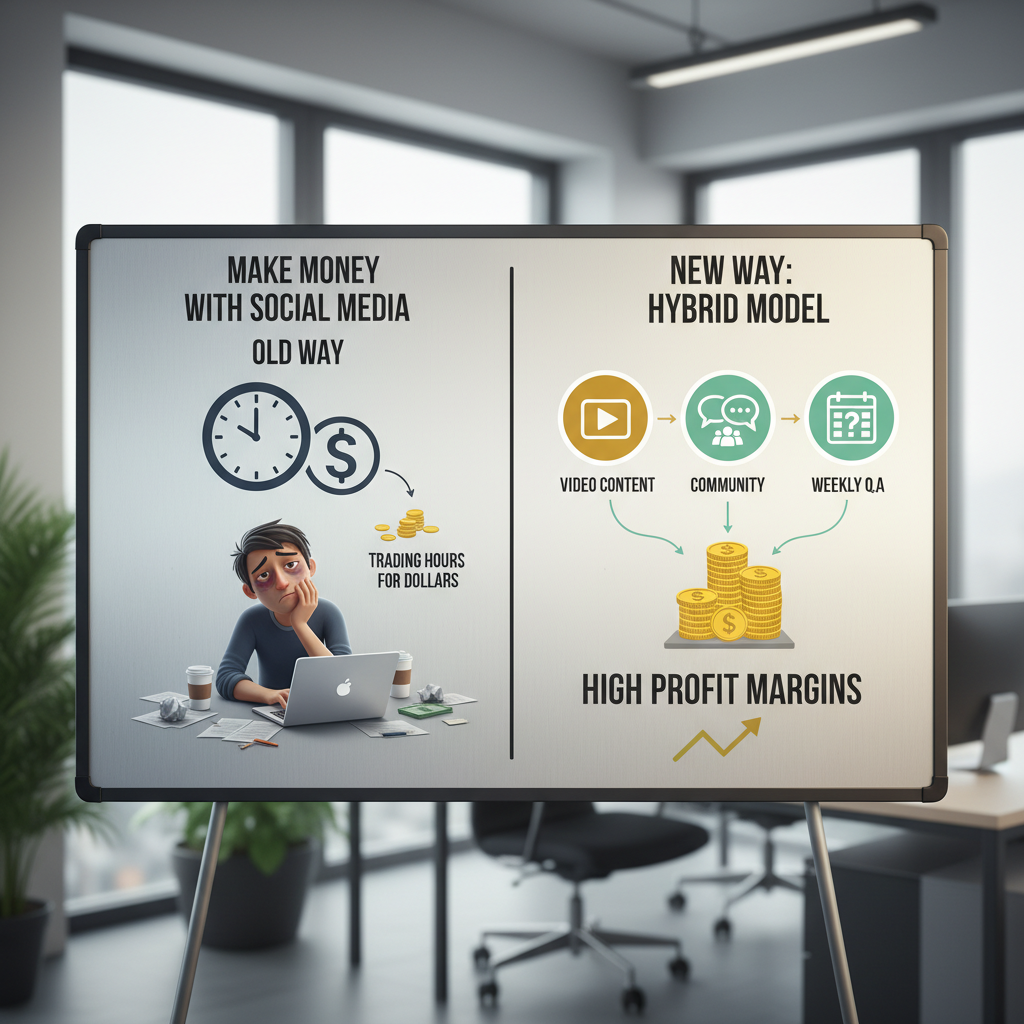
The most scalable model in 2025 isn’t pure 1-on-1 coaching (which caps your income) or a pure video course (which has low completion rates). It is the Hybrid Cohort Model.
- 20% Pre-recorded Content: The core curriculum (videos, SOPs, templates).
- 80% Accountability: Weekly Q&A calls, a community platform (like Skool or Circle), and feedback on their work.
A recent trend report from Teachable highlights that in the age of AI, community is the product. “Information is free; accountability and connection are premium.” This hybrid structure allows you to sell high-ticket without being on Zoom 40 hours a week.
Pricing Psychology
Why is $997 dead? Because it sits in the “Uncanny Valley” of pricing. It’s too expensive for an impulse buy, but cheap enough that buyers question the quality. $2,500 to $5,000 is the new standard for comprehensive transformation programs. At this price point, you attract clients who are serious, do the work, and get results—which leads to better testimonials.
The “Organic Authority” Engine (Traffic Strategy)
Now that you have an offer, do you need to spend $5,000 a month on Facebook ads? Absolutely not. In fact, for high-ticket sales, organic content often converts better because it builds deep trust over time.
The “Dan Koe” Method
Dan Koe, a creator generating millions annually, popularized the “content waterfall” strategy. He notes, “The one-person business model works because you are monetizing your obsession. You aren’t selling a course; you are selling a system you used to solve your own problem.”
Here is how the waterfall works:
- Long-Form (The Core): Write a deep-dive newsletter or record a YouTube video exploring a specific problem.
- Medium-Form (The Argument): Turn the key points into a LinkedIn post or Instagram Carousel.
- Short-Form (The Hook): Turn the punchiest quotes into Tweets or Reels.
This ensures you are everywhere, but you only had to come up with one big idea per week.
LinkedIn vs. Instagram: Know Your Battleground
According to HubSpot’s State of Marketing Report 2024, short-form video has the highest ROI of any marketing trend, with 67% of marketers increasing investment there. However, the platform depends on what you sell.
| Platform | Best For | Content Style |
|---|---|---|
| B2B, Career Coaching, Executive Consulting | Text-heavy, carousel PDFs, professional insights. | |
| Fitness, Lifestyle, B2C, Creative Skills | Stories (for selling), Reels (for reach). |
Case Study: Look at Justin Welsh. He built a $7M+ business almost exclusively on LinkedIn by writing about the business of being a creator. Conversely, Giulia Guerrieri generated over $3M in organic sales focusing heavily on Instagram Stories, proving that “DM closing” is a viable strategy for visual platforms.

The “No-Pitch” Pitch
You don’t need to scream “BUY NOW.” Instead, use “Hand-Raiser” posts. These are posts where you offer a free asset (like a case study or a short video) in exchange for a comment.
Example: “I just finished a 15-minute video breaking down how I signed 3 clients last week using cold email. Want to see it? Comment ‘VIDEO’ and I’ll send it over.”
This fills your DMs with qualified leads who have asked for your help. From there, you can transition into a sales conversation.
The High-Ticket Sales Funnel (Technical Implementation)
Complexity kills conversions. You do not need a 17-step email sequence. For high-ticket coaching, the most effective funnel in 2025 is the Application Funnel.
The Death of the Auto-Webinar
People are smart. They know your “Live Webinar starting in 5 minutes” is pre-recorded. It creates distrust. Instead, transparency wins. Send traffic to a VSL (Video Sales Letter) page that explains your methodology, shows proof, and asks them to apply.
Tech Stack Showdown
You need tools that are reliable. Here is the hierarchy of tech for 2025:
- The All-in-One King: GoHighLevel. It handles your website, funnels, email marketing, calendar booking, and even SMS automation. It is currently the industry leader for coaches.
- The Course Specialist: Kajabi. Still a strong contender if you want a beautiful user experience for your students, though it’s pricier and has weaker funnel capabilities than GoHighLevel.
- The Community Builder: Skool. If your offer is community-first (the Hybrid Model), Skool is unbeatable for engagement, though you may need external landing page software.
Use AI to qualify leads. Tools within GoHighLevel can now use AI bots to chat with leads via SMS to ensure they have the budget before they book a call on your calendar. This protects your time.
Closing the Deal: Financing & Objections
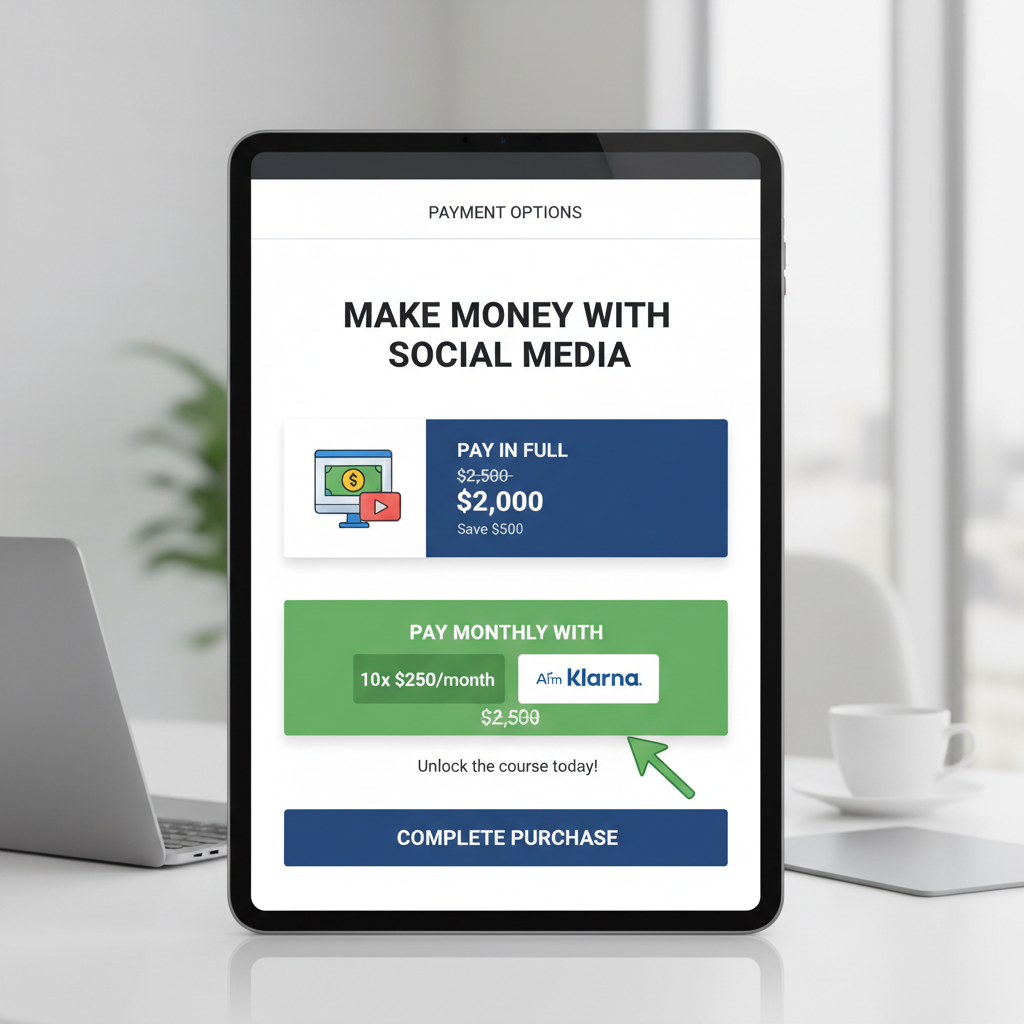
You’ve got them on the phone. They love the program. Then comes the dreaded phrase: “I can’t afford it.” In 2025, if you aren’t offering financing, you are leaving money on the table.
The “Buy Now, Pay Later” (BNPL) Revolution
Financing isn’t just for Peloton bikes anymore. According to data aggregated by Motley Fool Money from the Federal Reserve, 15% of all Americans used a BNPL service in the last year, with adoption jumping to 60% for Gen Z.
Integrating Affirm, Klarna, or PayPal Pay Later into your checkout process allows the client to pay in monthly installments while you get paid upfront (minus a merchant fee). This single switch can increase high-ticket conversions by 20-30%.
The Script: A 3-Step Framework
If you are on a Zoom call, do not “sell.” Diagnose. Here is a simple framework:
- Hell Island: Ask questions to understand their current pain. “What is the biggest bottleneck stopping you from X?”
- Heaven Island: Ask where they want to be in 6 months. “If we fix this, what does your life look like?”
- The Boat: Present your offer as the vessel to get from Hell to Heaven.
This isn’t manipulation; it’s clarity. As global social commerce sales approach $699 billion (eMarketer), consumers are comfortable buying online, but they demand clarity on the ROI.
Handling the “Is this a scam?” Objection
With the rise of “fake gurus,” skepticism is high. You counter this with Radical Transparency. Show the backend of your course on the call. Show raw screenshots of client wins (not just polished graphics). Admit who the program is NOT for. When you push people away who aren’t a good fit, you become more attractive to those who are.
Case Studies: Solopreneurs Who Cracked the Code
Justin Welsh: The LinkedIn Playbook
Justin is the gold standard for the “Knowledge Service” model. He doesn’t do high-ticket coaching anymore, but he built his fortune by proving the “Audience First” model.
- Strategy: He posts daily on LinkedIn (630k+ followers) and drives traffic to a weekly newsletter.
- Monetization: He sells low-ticket courses ($150) at massive volume. However, the principle remains: he built trust organically. If he released a $5,000 mastermind tomorrow, it would sell out in minutes because of the authority bank he has built.
Giulia Guerrieri: The Instagram Story Strategist
Giulia’s approach is different. She focuses heavily on the visual and lifestyle aspect of the creator economy.
- Result: $3M+ in sales.
- Strategy: She uses Instagram Reels to attract cold traffic, but the selling happens in the Stories. She shares client wins, “day in the life” content, and uses polls to identify interested leads, then closes them in the DMs. Zero ad spend required.
Frequently Asked Questions
Do I need a website to sell high ticket coaching?
Technically, no. Many creators start with just a LinkedIn profile and a Google Doc explaining their offer. However, to scale and build trust for a $2,000+ purchase, a professional landing page (using GoHighLevel or Carrd) is highly recommended.
What is considered high ticket coaching?
Generally, anything over $2,000 is considered high-ticket. This is the psychological threshold where customers stop impulse buying and need to speak to a human or see significant social proof before purchasing.
Is high ticket dropshipping or coaching better?
High-ticket coaching has significantly higher profit margins (90%+) compared to dropshipping (15-30%). With coaching, you are selling your intellectual property, so you have zero inventory costs and no shipping logistics.
How do I price my online course?
A good rule of thumb: Value the outcome at 10x the price. If your course helps someone make $50,000, a $5,000 price tag is a steal. If it saves them 100 hours of work, calculate the hourly value of that time.
Conclusion: Authority is the Currency of 2025
The era of gatekeepers is over. You do not need a publisher, a university, or a boss to validate your expertise. The market—specifically the $480 billion creator economy—is ready to validate you with their wallets.
But remember: selling high-ticket online courses isn’t about tricking people out of their money. It is about offering a premium level of service and transformation that actually changes lives. When you charge $2,000 instead of $20, you can afford to serve your clients deeper, hire better support, and build a sustainable business that doesn’t burn you out.
You have the expertise. You have the tech stack. The only variable left is your willingness to start posting.
Start building your authority today.