

Influencer Income Accelerator: Proven Strategies for Maximizing Brand Earnings & Renewals
Let’s address the elephant in the room: you keep hearing that the “influencer bubble has burst.” You see creators panic-posting about low views and ghosting brands. But if that’s true, why does the data tell a completely different story?
Here is the reality I’m seeing in the market: The “Deal Drought” is a myth. The money hasn’t disappeared; it has just moved. According to a 2024 report by Sprout Social, 26% of brands are now allocating more than 40% of their total marketing budget specifically to creators. They have the cash, but they are no longer handing it out for “brand awareness” alone. They are paying the creators who can prove efficacy.
In this guide, we are going to dismantle the old “pay-per-post” mindset. I’m going to walk you through the Influencer Income Accelerator framework—a business strategy that treats your creative career less like a gig economy hustle and more like a SaaS (Software as a Service) business, focusing on the “Retention Revenue Model.”
We will cover how to negotiate usage rights that double your fees, how to turn a one-off gift into a $25,000 annual contract, and how to use data to make yourself indispensable.

The 2025 Shift: From “Exposure” to “Efficacy”
In the early days of influencer marketing, brands were happy just to be seen. It was the “wild west” of metrics. Today, we are firmly in the “Era of Efficacy.” If you cannot draw a straight line between your content and a brand’s bottom line, you are leaving money on the table.
Understanding the $480B Market Opportunity
Before you undervalue your next contract, understand the scale of the economy you are operating in. According to Goldman Sachs’ 2024 “The Creator Economy” report, the total addressable market is projected to reach $480 billion by 2027. That is nearly doubling from 2023 figures. This growth isn’t coming from more celebrity endorsements; it’s coming from the democratization of marketing power.
Why Nano-Influencers Are Outperforming Celebrities
You might think you need a million followers to demand premium rates. However, the smartest brands are actually moving budget away from macro-influencers. Why? Trust and math.
Research published by Harvard Business Review in February 2024 indicates that Nano-influencers (under 10k followers) yield a remarkable 20x ROI, compared to just 6x for macro-influencers.
This “ROI Dominance” is your leverage. IZEA’s 2024 Trust in Influencer Marketing report supports this, finding that 62% of social media users trust influencers over A-list celebrities for product recommendations. When you pitch, stop apologizing for your follower count. Start highlighting your “Trust Score” and engagement depth.
— Ryan Detert, CEO of Influential (2024 Industry Outlook)

The “Income Accelerator” Negotiation Framework
Most creators price themselves based on a “feeling” or a generic calculator they found online three years ago. This is a mistake. To accelerate your income, you must decouple your time from your money.
Determining Your “Base + Bonus” Pricing Model
Stop offering a flat rate. A flat rate caps your upside. Instead, I recommend a “Base + Bonus” structure. Your base covers your production costs and audience access. The bonus (or performance kicker) rewards you for efficacy.
According to CreatorIQ’s “State of Creator Marketing 2025”, 74% of brands are prioritizing efficiency. They are often willing to pay a lower base if you agree to a performance tier (e.g., $50 bonus per conversion or $5 per 1,000 views over a certain benchmark).
The Art of Selling “Usage Rights” and “Whitelisting” (The Hidden Multipliers)
This is where the real margin lies. Many creators give away the rights to their content for free. In my experience, this is the single biggest leak in creator income.
Whitelisting (allowing a brand to run ads through your social handle) allows the brand to lower their Customer Acquisition Cost (CAC). Since you are saving them money on ads, you should charge a premium. Later’s 2024 Influencer Rates Guide notes that video rates vary, but usage rights are often calculated as a percentage of the base fee.
Case Study: The “Whitelisting” Multiplier
Scenario: A beauty creator with 50k followers usually charges $1,500 per Instagram Reel.
Strategy: She offered “Whitelisting Access” for 90 days. This allowed the brand to put paid spend behind her organic post.
The Pitch: “For an additional $2,000/month, you can run this creative as a dark post. You get the trust of my handle with the reach of your ad budget.”
Result: Total earnings jumped from $1,500 (one-off) to $7,500 (contract value). The work required? Zero extra minutes of content creation.
Interactive Usage Rights Calculator
Use this tool to estimate what you should be charging for exclusivity and usage rights on top of your base rate. (Note: These are industry standard multipliers, adjust based on your niche.)
Mastering the “Renewal Pitch”: The SaaS Approach
Acquiring a new brand partner is difficult. Keeping one is efficient. This is the core of the “Retention Revenue Model.” Yet, most creators treat the posting date as the finish line. In reality, the posting date is the starting line for your renewal negotiation.
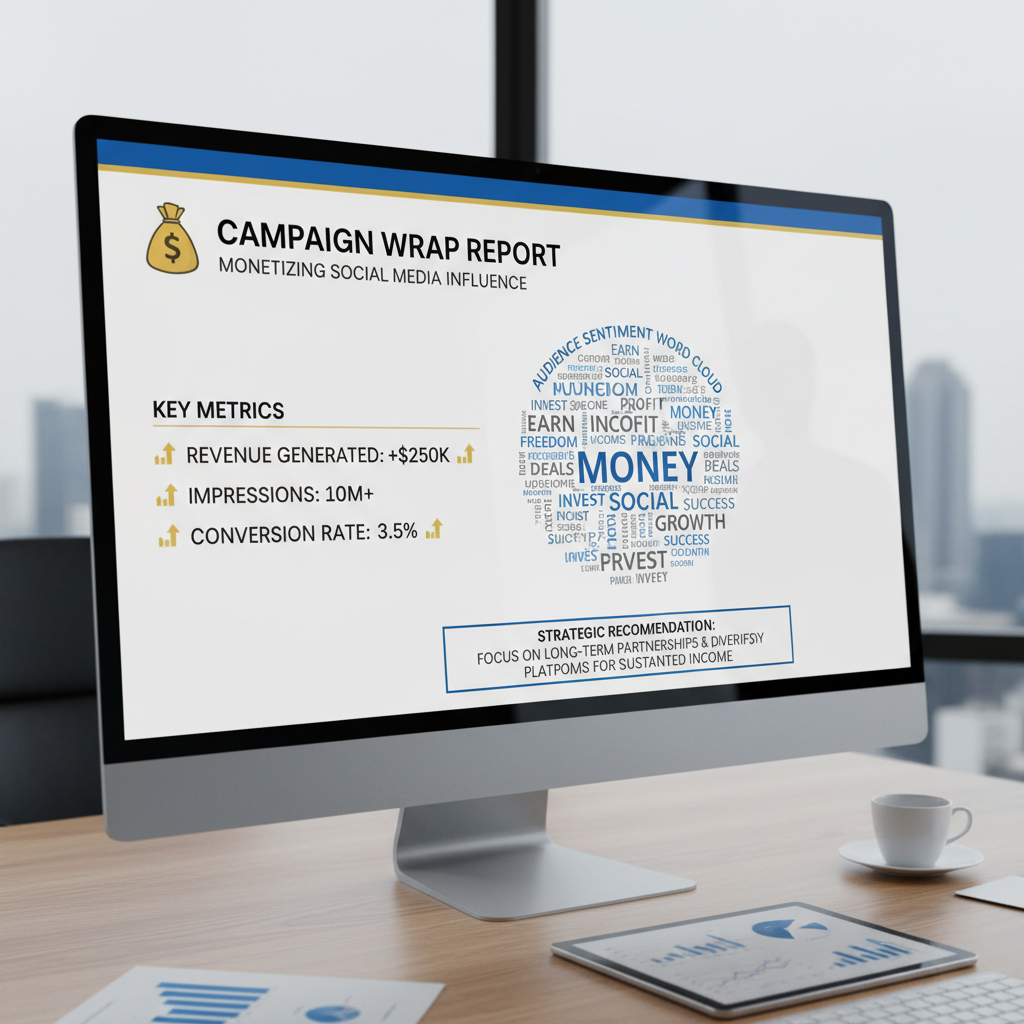
The Campaign Wrap Report: Your Secret Weapon
If you wait for the brand to tell you how the campaign went, you’ve lost control of the narrative. You need to send a proactively structured Campaign Wrap Report within 7 days of the campaign ending.
According to Influencer Marketing Hub’s 2024 Benchmark Report, approximately 60% of brands intend to increase their budgets in 2025, specifically favoring creators they have previously worked with. They want safety. Your report provides that safety.
What to Include (Beyond Screenshots):
- Sentiment Analysis: Don’t just show comments; categorize them. “15% of comments mentioned purchasing,” or “Users specifically asked about the [Product Feature].”
- Saved/Share Ratio: High shares indicate viral potential. High saves indicate purchase intent.
- Cost Per Engagement (CPE): Calculate this for them. If your CPE is lower than the industry average ($0.15-$0.50 depending on platform), highlight it in bold red text.
Scripting the “Upsell Conversation”
Once you’ve sent the report, don’t ask “Do you want to work together again?” That’s a yes/no question that is easy to reject. Instead, use the “Presumptive Close.”
“Based on the high save rate (12%) on the last Reel, my audience is clearly in the research phase for this product. I’ve drafted a 3-month roadmap to convert those ‘saves’ into ‘sales’ through a series of tutorials. Here is what that looks like…”
— Justin Moore, Sponsorship Coach & Founder of Creator Wizard
Diversifying Income Streams Within Brand Deals
Another way to accelerate income without finding new clients is to expand the menu of services you offer to existing clients.
Offering UGC-Only Packages
Some brands have massive ad budgets but terrible creative teams. They don’t need your followers; they need your camera skills. You can offer User Generated Content (UGC) packages where you create the video, but you never post it to your own channel.
This is highly profitable because there is no “audience fatigue” risk. You can sell a bundle of 5 TikTok-style videos for the brand’s own use. Since you aren’t “burning” your audience, you can do this for competitors or multiple brands simultaneously (barring exclusivity clauses).
Moving Beyond the Feed: Newsletter & Podcast Sponsorships
The HubSpot State of Marketing 2024 report emphasizes that marketers are looking for “omnichannel” presence. If you have a newsletter or a broadcast channel, pitch it as an add-on.
Why it works: Email has a higher conversion rate than social media. Bundling a “Link in Bio” mention + a Newsletter blast creates a full-funnel approach that smart CMOs love.
Technical Tools for Income Acceleration
To run this like a business, you need the right tech stack. You cannot scale if you are building media kits in Microsoft Word.
AI for Media Kits and Pitching
Your media kit needs to look like a glossy magazine ad, not a resume. Tools like Canva and Adobe Express now utilize AI to update your metrics dynamically. More importantly, use platforms that brands already trust for data verification.
Analytics Platforms Brands Trust
When you send screenshots, they can be faked. Using verified data from platforms like Sprout Social or linking your account to Tagger (by Sprout Social) gives you immediate credibility. It signals to the brand that you aren’t hiding anything.

FAQ: Navigating the Business of Influence
What is a good engagement rate for brand deals in 2025?
While it varies by platform, generally, an engagement rate between 2% and 3.5% on Instagram is considered healthy for influencers with 10k-50k followers. For TikTok, brands often look for rates above 5-7%. However, remember the shift to efficacy: a lower engagement rate with a high click-through rate (CTR) is more valuable to a brand selling a product.
How much should I charge for usage rights?
A standard starting point is 30% of the base fee for 30 days of digital usage. If a brand wants “perpetuity” (forever) rights, you should be charging 2x to 4x your base rate, as you lose the ability to work with competitors in that video’s context forever.
How do I calculate ROI for influencer campaigns to show brands?
The simplest formula for a creator is: (Revenue Generated – Creator Fee) / Creator Fee * 100. If you don’t have access to revenue data, calculate the “Media Value.” If the brand usually pays $5 CPM (Cost Per Mille/Thousand) for ads, and you generated 100,000 views, your organic media value is roughly $500. Use this in your wrap reports.
Conclusion: The Era of the Creator-Entrepreneur
The “Influencer” title is becoming outdated. It implies passivity. The future belongs to the Creator-Entrepreneur.
The data from Goldman Sachs and Sprout Social is clear: the money is there, but the bar has been raised. Brands are no longer paying for vanity metrics; they are investing in partners who understand their business goals. By shifting your focus from “getting the next deal” to “maximizing the lifetime value of current deals,” you stabilize your income and build a defensible business moat.
Your Next Step: Do not just close this tab. Go audit your last three brand collaborations. Did you send a wrap report? Did you offer an upsell? Did you charge for usage rights? If the answer is no, use the checklist and calculator in this article to prepare for your next negotiation. The accelerator is right in front of you; you just have to press the pedal.