

Beyond Sponsored Posts: The Blueprint to Negotiating 6-Figure Brand Partnerships
Stop selling posts. Start selling influence, data, and distribution.
If you are still charging a flat fee for a “shoutout” or a single Instagram Reel, you are leaving 50% to 70% of your potential revenue on the table. In my years consulting with top-tier creators, the biggest mistake I see isn’t bad content—it’s bad business models. You aren’t just a “content creator” anymore; you are a full-scale media production company, and it’s time you started billing like one.
The days of the $500 one-off post are fading for serious professionals. We are entering the era of the $50,000 annual partnership, built on complex deliverables like usage rights, whitelisting, and exclusivity. If you want to move from gig worker to business owner, you need to understand the economics of the creator industry.
The Shift: Why Brands Are Moving $22 Billion into Partnerships
You might be wondering why a brand would pay you a retainer instead of just hiring you for a quick campaign. The answer lies in the data.
The market is maturing rapidly. According to a February 2025 report from Collabstr, the influencer marketing industry is projected to reach $22.2 billion by 2025, growing approximately 12.1% from 2024. Brands aren’t just testing the waters anymore; they are moving massive budgets away from traditional TV and billboards into the creator economy.
Furthermore, Goldman Sachs projects the total addressable market of the creator economy could reach a staggering $480 billion by 2027. This capital influx signifies a shift toward professionalization. Brands crave safety and consistency. They know that one-off posts often fall flat because audiences need repeated exposure to trust a product.
However, saturation is real. Collabstr’s 2024 data showed that the average spend per influencer collaboration actually dropped 16.8% to $214 due to market saturation. This sounds scary, but it’s actually an argument for premium positioning. The “middle class” of influencers charging average rates for average work is getting squeezed. The creators who negotiate for rights, data, and retainers are the ones seeing their incomes skyrocket.
The “6-Figure” Ecosystem: It’s Not About the Post Count
To negotiate a 6-figure deal, you must decouple your time from your money. You are no longer charging for the 3 hours it takes to film a video. You are charging for three distinct assets:
- Production: The creation of the asset.
- Distribution: Access to your audience.
- Usage: The right for the brand to use your work elsewhere.
Selling “Usage Rights” (The Revenue Multiplier)
This is where most creators lose money. Under US copyright law, you own the content you create. When a brand pays you for a “sponsored post,” they are usually paying for the right to have that post appear on your feed for a specific time.
If they want to take your video and run it as an ad on Facebook, put it on their website, or use it in a newsletter, they must pay “rent” on that content. This is called Usage Rights Licensing.
The Formula: never include usage rights in your base fee. If your base rate for a Reel is $2,000, and the brand wants to use it for paid ads for 3 months, you should charge an additional percentage (typically 30-50% of the base rate per month).
Whitelisting & Spark Ads
Whitelisting (or Spark Ads on TikTok) is a massive leverage point. This involves granting the brand access to your backend advertising tools to run ads through your handle. To the viewer, it looks like an organic post from you, but it’s funded by the brand’s ad budget.
Why is this valuable? It lowers their Cost Per Acquisition (CPA). Because it benefits them so heavily, you must charge a premium. I recommend charging a flat monthly “access fee” for whitelisting, distinct from content creation fees.

The Exclusivity Premium
When a skincare brand hires you, they usually demand you don’t work with other skincare brands. This is exclusivity.
Here is the trap: If you sign a 3-month exclusivity clause, you are legally barred from accepting money from competitors. That is an opportunity cost. You must calculate how much potential income you are losing by saying “no” to other deals and bill the current brand for that silence.
Analyzing Your Data Like a CFO (Preparation)
Before you enter a negotiation, you need leverage. Brands don’t care about your follower count as much as you think. They care about conversion.
Beyond Follower Count: Engagement & Conversion
Interestingly, you don’t need a million followers to command high rates. According to a May 2024 report by the Harvard Business Review, influencers with fewer than 10,000 followers often yield a 20x ROI compared to macro-influencers.
Use this data in your pitch. If you are a nano or micro-influencer, frame your smaller audience as a “highly concentrated, high-conversion community” rather than a “small following.”
Audience Demographics & Purchasing Power
Take screenshots of your backend analytics. A brand selling premium luggage doesn’t just want “people.” They want “US-based frequent travelers aged 25-45.” If your data proves you have that exact demographic, your rates should double immediately.

The Negotiation Strategy: From Pitch to Contract
I’ve seen many creators crumble when a brand says, “We don’t have the budget.” Here is the thing: they almost always have the budget; it’s just allocated to a different department (like paid media). Your job is to unlock it.
The Anchor Price Technique
Never send a single price. Always send three tiers. The “Anchor Price” is your highest tier—the “Platinum Package.” It should include everything: retainer, whitelisting, 12 months of usage, and exclusivity.
Even if they say no, you have anchored their expectation of your value. When they look at your middle tier, it will seem affordable by comparison, even though it’s higher than your original “single post” rate.
Redlining the Contract (Protecting Your Future)
The contract is where you protect your business. There are specific terms you must watch out for to ensure you aren’t being exploited.
of influencers would rather be involved in creative development early than follow a rigid brief. (Sprout Social, 2025)
Use the accordion below to understand the critical legal terms you must negotiate:
What it means: The brand owns the rights to use your face and content forever.
Why it’s dangerous: Imagine you become famous in 5 years, but a cheesy ad you made for $500 is still running on TV because you signed perpetuity rights. It can also block you from future high-value deals with competitors.
The Fix: Replace “in perpetuity” with “for a period of [X] months.”
What it means: This determines who pays for legal fees if something goes wrong (e.g., a lawsuit over the content).
The Fix: Ensure the brand indemnifies you against claims related to their product (e.g., if their face cream burns someone, you shouldn’t be sued). You should only indemnify them for copyright breaches on your end (e.g., using unauthorized music).
What it means: A cancellation policy.
The Fix: If a brand cancels a campaign after you’ve done the work but before it goes live, you still need to be paid. Standard kill fees are 50% of the total project fee if cancelled after contract signing, and 100% if cancelled after content delivery.
Structuring the Deal: 3 Tiered Packages
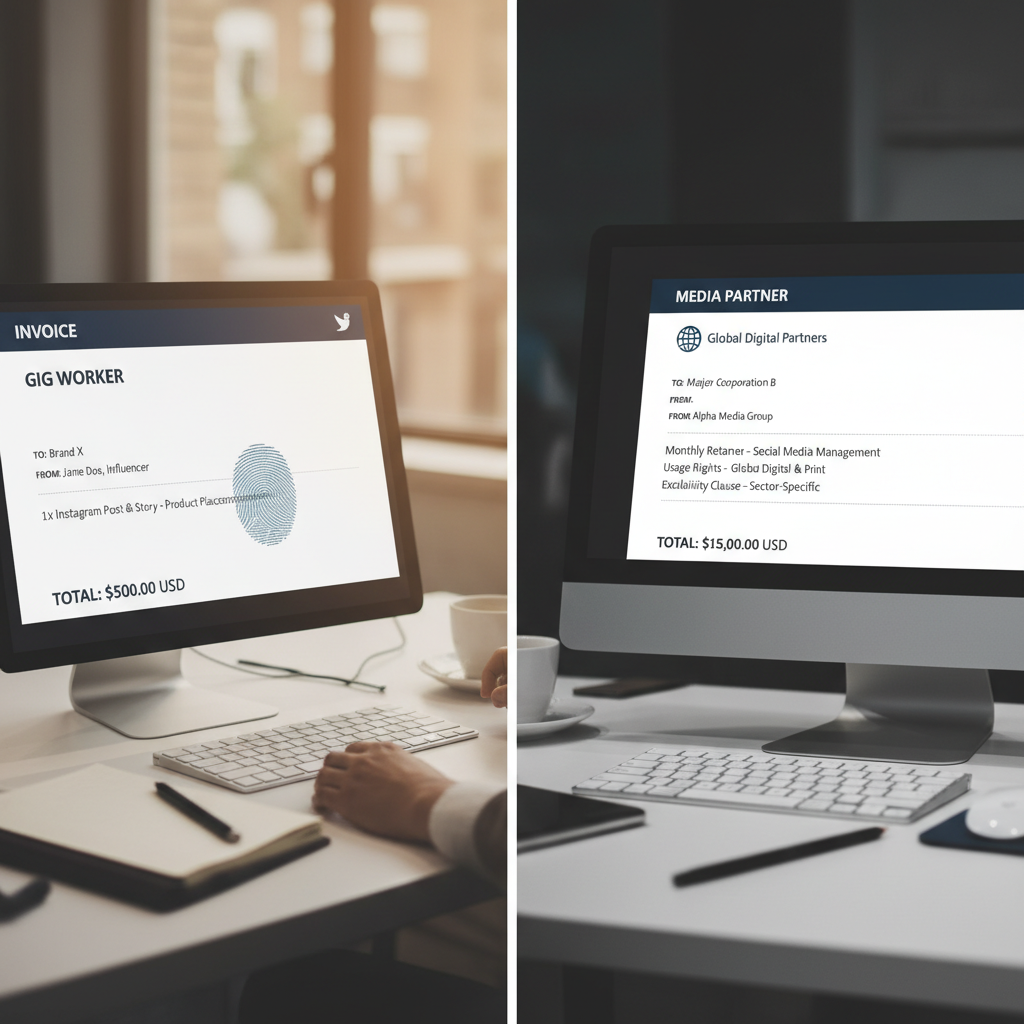
To help you visualize this, here is a comparison of how a “Gig Worker” structures a deal versus a “Media Partner.”
| Deal Component | The $500 Approach (Gig Worker) | The $5,000+ Approach (Media Partner) |
|---|---|---|
| Deliverables | 1 Instagram Post | 1 Reel + 3 Stories + raw files |
| Usage Rights | Included (often accidentally perpetuity) | Paid Ads Usage (3 Months): +$1,500 |
| Whitelisting | None | Access Fee: +$1,000/mo |
| Exclusivity | None | 30 Days Category Exclusivity: +$1,000 |
| Total Value | $500 | $5,000+ |
Interactive Tool: Usage Rights Calculator
Not sure what to charge? Use this simple calculator to estimate a starting point for paid media usage rights. (Note: This is a baseline estimation tool).
Long-Term Thinking: The Ambassador Model
The ultimate goal of influencer brand partnership negotiation is the “Ambassador Retainer.” This is where you sign a 6 or 12-month contract.
Why do brands love this? According to Influencer Marketing Hub’s 2024 Benchmark Report, 60% of marketers with dedicated budgets plan to increase spending in 2025. They want reliable partners who understand their brand voice, reducing their administrative workload.
To pitch this, analyze your best performing organic post for the brand. Pitch a “Content Series” based on that format. Offer a bulk discount (e.g., 15% off) in exchange for a guaranteed 6-month contract. This stabilizes your cash flow and allows you to build a team.
Conclusion: From Creator to CEO
The transition from posting for free gifts to negotiating 6-figure contracts requires a fundamental mindset shift. You are not asking for a favor; you are selling a valuable business solution: customer acquisition.
Remember, the market is on your side. With TikTok and Instagram holding 42% market share each, the demand for authentic, platform-native content has never been higher. But authenticity doesn’t mean working for free. HubSpot’s 2024 report confirms that 63% of consumers value authenticity over polish. You have the authenticity; now you need the contract to match.
Review your media kit today. Remove the “flat rates.” Add a section for “Usage & Licensing.” Draft your tiered packages. The next time a brand emails you, don’t just send a price—send a partnership proposal.